

10 Things To Do In Bruges
'Oh god, oh god, oh god... no, no, no, no, no!' Probably not the words anyone's partner wants to hear, but when it comes to riding pillion on a rickety tandem down Bruges' cobbled streets, the control freak in me just can't be contained. Death-defying cyclepades aside, Bruges' beautifully preserved medieval architecture, guilty pleasure-esque cuisine (chocolate and chips, anyone), and centuries-old beer culture make it the ideal destination for a weekend break. I hopped on the Eurostar to explore it with my husband and two dear friends for my 35th birthday, and it definitely made inching ever-closer to 40 more bearable. Here is my humble guide to the fairytale city. READ MORE...
'Oh god, oh god, oh god... no, no, no, no, no!' Probably not the words anyone's partner wants to hear, but when it comes to riding pillion on a rickety tandem down Bruges' cobbled streets, the control freak in me just can't be contained. Death-defying cyclepades aside, Bruges' beautifully preserved medieval architecture, guilty pleasure-esque cuisine (chocolate and chips, anyone?), and centuries-old beer culture make it the ideal destination for a weekend break. I hopped on the Eurostar to explore it with my husband and two dear friends for my 35th birthday, and it definitely made inching ever-closer to 40 more bearable. Here is my humble guide to the fairytale city...

1: Take a canal tour
Known as The Venice Of The North, the best way to see Bruges is by boat. Exploring this city really is like stepping into a fairy tale: think weeping willows, beautifully preserved medieval architecture, cobbled pathways and bridges, and soaring towers. Gliding around in a canal boat only adds to its dreamlike quality. There are five docks from which to take the tour and, due to local licensing laws, all the boat operators offer the same trip for a totally reasonable €8. The city’s official website says tours run from March to mid-November, but we went at the end of February and the boats were running all day.
€8; https://www.visitbruges.be/canalsofbruges

2. Drink beer
Alongside Germany, Belgium is famous for having one of the longest brewing histories in the world. In fact, beer is so synonymous with the country that in 2016, UNESCO inscribed Belgium’s beer culture on its list of the intangible cultural heritage of humanity: it is an integral part of the country’s daily life. It is a culture steeped in tradition, knowledge and skill, and Belgians promote responsible production and consumption (side note: I don’t think we saw a single drunk person on our trip). We did the XL Tour at the local De Halve Maan Brewery, which has been run by the Maes family for centuries (the current site has been open since 1856). I’ll confess, I’m not really a beer fan, but even I was impressed by the passion and commitment behind the product. At the end of the tour, we tasted three of its beers: a refreshing unfiltered Bruges Zot that is only sold on-site, a Dubbel and a deliciously chocolately (and dangerously so at 14%) Tripple Staffe Hendrik. A must-do.
€19pp, 2.15pm daily; https://www.halvemaan.be/en/brewery-visit

3. Eat, pray, drink chocolate
Belgium and chocolate go hand in hand, and the chocolate in Bruges doesn’t disappoint. Also, it’s everywhere! Alongside Switzerland, Belgium is one of Europe’s primary chocolate producers. Brought to Europe in the 1600s from Mesoamerica, by the 18th century hot chocolate was a favoured drink among the Belgian middle and upper-classes. Strolling around Bruges, there are chocolatiers on every street, offering chocolate in every form imaginable. We stopped at The Old Chocolate House for a cup of its famous hot chocolate and, while it was indeed delicious, the service was somewhat lacking. I bought two takeaway cups in quick succession (#sorrynotsorry) and while waiting for the second to brew, asked to use the loo and was briskly told it was for customers only. This was after spending €4. I asked for my money back and stropped out. Namaste, bitches.

4. And waffles… and chips... and all the food
Basically, Bruges is one big guilty pleasures choff-fest. Prepare to roll out a kilo heavier than when you arrived. We joined the long but fast-moving queue for waffles at famous stall Chez Albert, and weren’t disappointed (pillow-soft with just the right amount of crispiness around the edges, topped with melted dark chocolate and whipped cream). High-fat foods aside, we had an amazing dinner at Kok Au Vin: confit beef with beetroot and goats cheese to start (mackerel and kohlrabi for pescetarian me), an innovatively moreish cod, fennel and mushroom linguine, and an electrifying yuzu, coconut and pineapple pudding. So much flavour, so much texture, so much care and thought put into each and every plate. We also had a delicious, if rather staid, dinner at Bonte B: the cod with truffle gravy and mash was one of the best things I’ve ever eaten, but the atmosphere was tense and too quiet to properly relax. If you want something more casual, Vino Vino is a fun, lively tapas bar with an unassuming typed menu that belies just how inventive the food is. The Asian-inspired aubergine fritters were so good we ordered them twice. And if you’re after a nightcap, then On The Rocks is a Bruges institution. Yes, it smells of petrol (your guess is as good as mine), but the owner Tony is a real character with the voice of an angel (we were treated to some operatics) and the drinks are reasonably priced and good.

5. Climb Belfry Tower
I have a confession: we didn’t actually climb the Belfry Tower. I know, I know, who goes to Bruges and doesn’t climb the Belfry blimmin’ Tower? But I’d recently had steroid injections in my knee and 366 steps up a narrow staircase didn’t seem like a good idea at the time (listening to my body = yoga in action my friends). Standing at 83 metres tall, it houses a carillon with 47 bells, which ring out melodically around the famous square beneath it. Once you get to the top you’re rewarded with breathtaking panoramic views, which I was a bit gutted about missing, but the view from the top of the brewery was good enough for me. Get there early (it opens at 9.30am) to beat the crowds.
€12; https://www.visitbruges.be/en/belfort-belfry

6. Visit the churches
Put simply, Bruges' churches are majestic. As an atheist, I find it hard to get excited about churches and generally find them pretty eerie places to be, but the Church Of Our Lady has an original Michelangelo sculpture (Madonna And Child), while the Basilica Of The Holy Blood is alive with colour and holds a vial containing a cloth with what is said to be the blood of christ.
https://www.visitbruges.be/en/onze-lieve-vrouwekerk-church-of-our-lady

7. Cycle to Damme
Belgium is famous for its waterways, and its flat terrain is perfect for leisurely canalside cycles. We hired bikes on the Sunday and it was one of the highlights of our trip. We rather ambitiously thought tandems would be LOL-worthy; in reality, I lasted less than one minute on the back before the control freak in me said no. Then the chain came off our friends’ one, so back to the bike shop it was to swap the tandems for regular bikes (who’s laughing now, eh?) and cycle the canal path 6km north-east from Bruges to the little village of Damme for lunch. Although bitterly cold, the sun was shining and the route is lined with windmills and farms. Once in Damme, we raced to the nearest place we could find for food and warmth (the feeling had completely gone in my hands by this point), and stumbled into the welcoming De Damse Poort: relaxed, laid back vibe with amazing local produce and delicious wine. One helping of fried sole and frites (for me, a mammoth tomahawk steak for everyone else to share) later, along with copious glasses of fizz, wine and beer, we merrily pootled back along the canal to Bruges, completely immune to the -15C wind chill. Definitely worth doing if you have the time.
Bike hire €10 for 4 hours, http://www.brugesbikerental.be

8. See the windmills
We incorporated a little tour of Bruges’ famous windmills on our way to Damme, but you can also walk along the ramparts and take them in en route. Belgium is famous for its rich mill history, with Bruges having 23 windmills in the 16th Century. Nowadays there are four remaining, between Dampoort and the Kruispoort. Sint-Janshuismill is the oldest mill (built in 1770) and a vibrant pink. It’s still used to grind flour and has a museum too.
https://www.visitbruges.be/en/windmills-of-bruges

9. Timetravel at the Begijnhof (Beguinage)
Step back in time to 17th Century Bruges and take a tour around the former homes of the ‘beguines’, emancipated laywomen. Nowadays, the nuns from the Order Of St. Benedict live at the beguinage, but the white-fronted houses remain beautifully preserved with peaceful surrounding gardens. Again, we took in the beguinage on our DIY cycling tour, but you can visit daily for just two Euros.
€2, https://www.visitbruges.be/highlights/beguinage

10. Stay in a ‘tall’ house
We decided to save money on accommodation (all the more for food and beer) by eschewing hotels and instead stumbled across a wonderfully restored traditional Flanders-style ‘tall’ townhouse on AirBnB. With three bedrooms, two bathrooms, a spacious living room, an open-plan kitchen and dining area and a roof terrace (we didn’t brave it on our trip: it was far too cold to hang around outside), there was more than enough room for the four of us. The owner Kevin and his partner have an amazing eye for design: think stripped-wood floors, exposed beams and brickwork, minimalist Scandi-style furniture and all the mod cons (WiFi, speakers, TV with Netflix if you fancy a night in, proper coffee maker etc). Just be careful coming down the spiral staircase, especially after a few Bruges Zots!
Kevin’s house is available from £137 a night; click here to book


Stop Trying So Hard
K.I.S.S. You’ve probably seen this acronym before. Keep. It. Simple. Stupid. It’s so obvious when you think about it. Hands up, how many times have you worked on a project, decided it wasn’t ‘enough’, then layered on numerous extra flourishes that, in all honestly, probably didn’t need to be there. I’ve lost count of the amount of times I’ve worked and reworked a piece of copy/a yoga flow/an outfit, only to scrap everything and revert to the original, and often simplest, incarnation. READ MORE...
K.I.S.S. You’ve probably seen this acronym before. Keep. It. Simple. Stupid. It’s so obvious when you think about it. Hands up, how many times have you worked on a project, decided it wasn’t ‘enough’, then layered on numerous extra flourishes that, in all honestly, probably didn’t need to be there. I’ve lost count of the amount of times I’ve worked and reworked a piece of copy/a yoga flow/an outfit, only to scrap everything and revert to the original, and often simplest, incarnation.
The thing is, this acronym exists for a reason: simple is best. Overcomplicating is unnecessary, and it’s a mantra I’ve started applying to my yoga classes. I’ll admit, initially it wasn’t by choice. An old knee injury is playing up and as a result I can’t demonstrate (or practice, a challenge in itself), so I’m relying solely on what I say when I lead students through a practice. This means I have to go in to my classes with complete clarity: I need to know what I want to teach, and how to get my students there in the simplest possible way.
'Our life is frittered away by detail. Simplify, simplify'
– Henry David Thoreau
Now, when I started teaching I was definitely swayed by the ‘more is more’ ethos that permeates certain pockets of the yoga scene. I thought that in order to teach good classes, I had to offer everything for everyone, all at once. You can guess how that went down. I felt muddled and completely unclear as to what I was trying to communicate.
Naturally, I began to feel burnt out, so I started to reassess what I was doing. I started seeking out simplicity and grounding because it was what I wanted to both do and teach. Don’t get me wrong, I love a strong practice and fancy pants poses, but all at once? Hell no! It doesn’t feel good in mind or body, on either side of the student/teacher fence. I don't learn that way, and I'm betting most of you don't either.
Enter Jason Crandell, aka the king of intelligently sequenced, confidently simple, alignment-focused vinyasa flow. I started training with Jason in October last year and honestly, it has revolutionised my teaching.
A lot of what Jason champions was instilled in me during my first training with Stretch and Frog Lotus Yoga (thank you Carl and Vidya), but I think I needed to hear it again and build confidence to teach what I believe in. Simple, sustainable practices that build towards peak poses in a methodical way. The result? Less striving, more spaciousness and ease when you practice. And, as I’ve been noticing in my students, more confidence and understanding when it comes to the peak poses we’re working towards.
'If you can't explain it to a six year old, you don't understand it yourself' – Albert Einstein
This is the thing: how can you teach effectively when you don’t know what your objectives are? Yes, I get that you need to read the room and students’ energy and abilities, but you need to respond to these factors within a clear, defined framework.
Case in point: the past couple of weeks we’ve been exploring back of core and backbends, working towards backbends and binds with a strap. Cue lots of preparation opening up the shoulders, hips and quads, and strengthening the back body, glutes and hamstrings, and lots of layering poses as we build towards our peak postures.
I’ve seen students who previously struggled with postures such as wheel and dancer find new strength and depth in their backbends because the simple, logical nature of the sequence means they can understand where to engage and where to soften, and that it’s a process. As a teacher, it’s been fascinating to watch and incredibly rewarding.
So, to come back to my original point, simple is good. Simple is more than good, it’s bloody amazing, both on and off the mat. When we keep things simple we allow ourselves space to grow and learn at a pace that is sustainable, and we also create room in our minds and bodies to fully understand something. And isn’t that what this practice is about: patience, listening and letting ourselves be absorbed in the present, without worrying about needing to perfect the next big thing? Letting go of the need to have everything all at once and instead honing and finding a depth to our craft?
Simplicity is aparigraha (non-attachment) in action, people. Let's embrace it. I think we'd all be far happier for it.

A New Dawn
You know how it goes. Wake up, check phone, thumb effortlessly switching between apps, a motion so ingrained it's almost as natural and involuntary as breathing. Before you know it, you’ve woken an inner narrative questioning why you don’t look like/are as successful as/have the lifestyle of x, y or z. Sound familiar? READ MORE...
You know how it goes. Wake up, check phone, thumb effortlessly switching between apps, a motion so ingrained it's almost as natural and involuntary as breathing. Before you know it, you’ve subconsciously woken an inner narrative questioning why you don’t look like/are as successful as/have the lifestyle of x, y or z. Sound familiar? I hear you.
A few weeks ago, my Monday morning started exactly as above. I wasn't teaching my first class till lunchtime, so I woke up, fed the pets, made some coffee, started mindlessly scrolling. Then, as keeps happening since I’ve started meditating daily (more on that another time), I caught myself mid-self-destructive thought cycle. I witnessed that aforementioned narrative loop as it was building and building (and building) and said STOP.
I mean seriously, I’m a 35-year-old woman and, quite frankly, I just don’t have time for that nonsense anymore. And besides, regardless of age (or gender), you shouldn’t be letting that rhetoric seep insidiously into the corners of your mind, slowly leaching your sense of worth and self-esteem, while also quite literally changing how your brain functions.
'We are destroying how society works'
In December, Facebook's former vice president for user growth Chamath Palihapitiya gave a damning keynote speech at a Stanford Business School event, saying: 'The short-term, dopamine-driven feedback loops that we have created are destroying how society works. No civil discourse, no cooperation, misinformation, mistruth.' Moreover, the social media giant's founding president Sean Parker claimed that Facebook 'exploit[s] a vulnerability in human psychology' by creating a 'social-validation feedback loop'.
Hearing Palihaptiya's speech on Radio 4 one evening planted a seed: what was my social media consumption doing to the way my brain worked? As someone who suffers from anxiety and depression, was I making myself worse? As yoga teachers, there is an increasing pressure to have a large social following, to 'build your brand', so to speak.
But, as my teacher Jason Crandell wisely pointed out during training last month, is it worth investing all your time and energy creating content that people expect to get for free? Surely we should be instead investing said time and energy into the stuff that really deepens our knowledge and understanding of this practice, so that we can in turn serve our students better. To focus less on creating content for social media and more on creating a rich, textured curriculum for the people actually willing to pay for our knowledge (the knowledge we've spent thousands on trainings to gain) so they can develop and grow? To me, the answer is clear.
'change your consumption habits'
The thing is, I actually quite like Instagram (and it’s Instagram, coincidentally owned by Facebook, I’m focusing on here, so synonymous it is with modern yoga). When I’m feeling mentally strong, I find it a wonderful way to stay connected to my community, and I also find it motivational and inspiring – to a degree. I often find myself scrolling, watch an beautiful flow or new transition and peel myself off the sofa and go practice as a result. Many of the teachers I love and respect post really valuable, knowledgeable content.
Personally I notice a huge difference in how social media affects me depending on the time of day I consume it. Mid-afternoon? Often leads to a practice. Early evening? I just like looking mindlessly at beautiful pictures with Netflix on in the background and the pets on my lap. But first thing in the morning? Hell no! That just sets me up for a day of self-loathing and self-doubt. I mean, it’s just not healthy to wake up, see what everyone else is doing (only a million times better than you, because everyone is #livingtheirbestlife online) and start the day feeling like you're not ‘enough’, is it?
So, after noticing a pattern in my social media consumption and moods, I decided to try a little experiment. No Instagram first thing. In fact, no Instagram till after I’d done the things that enrich me, and even then maybe none at all that day. For me, that means waking up, feeding pets, meditating, drinking coffee, going to teach, then a swim or a practice, then I'll allow myself a peek. In short, no social media pre-midday. After two weeks, I can already notice a big difference, so I'm being strict with myself and sticking to it. Why don't you give it a go, and let me know how you get on? Let's embrace this new dawn, one in which social media doesn't rule the day.

Raw Chocolate And Almond Butter Bites
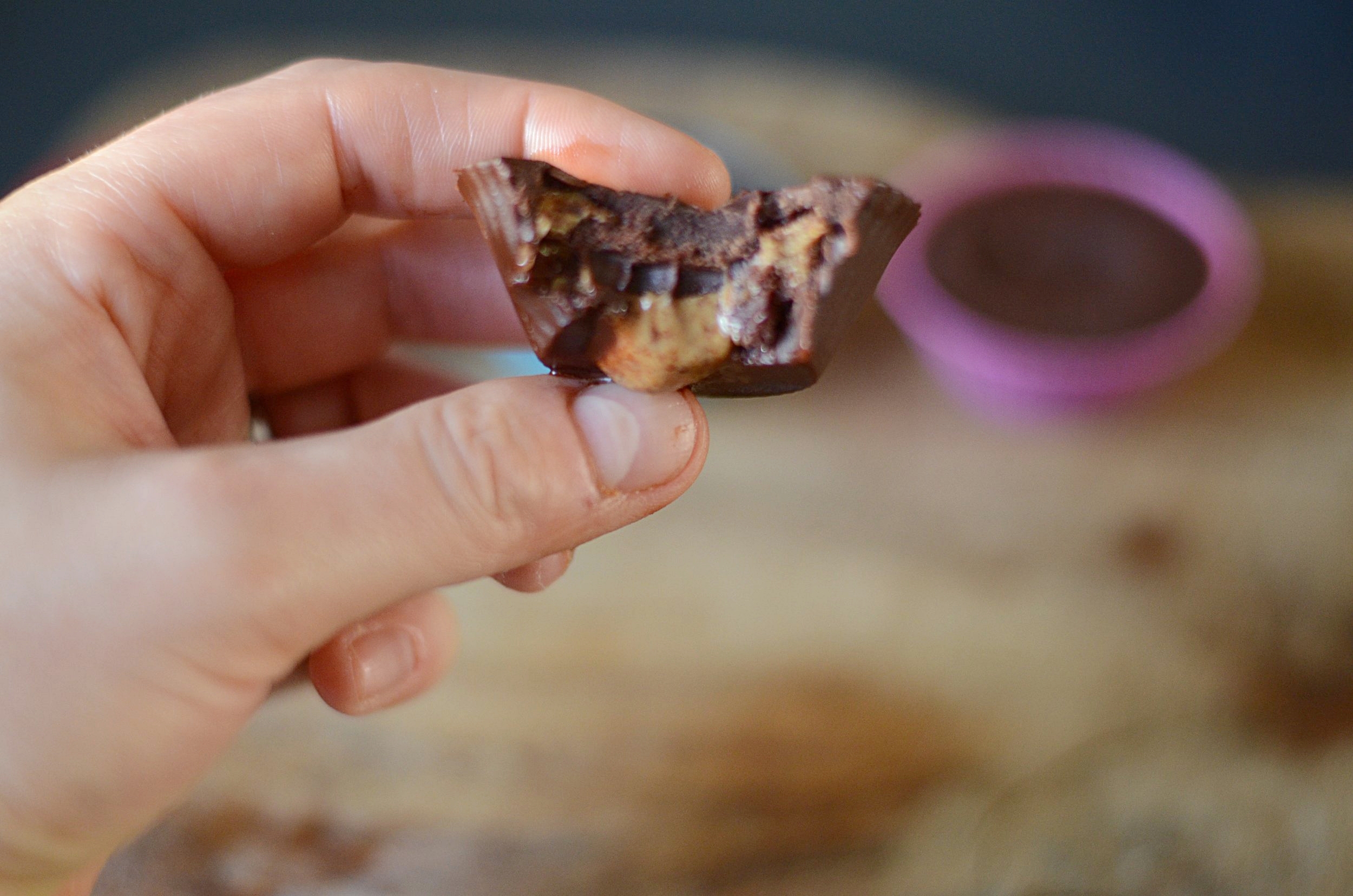
Confession: I’ve been dreaming of making these Reese’s Pieces-esque cups ever since my little sister (twin one) sent me a late night WhatsApp pic of the cups she made with actual chocolate and peanut butter. I drooled a lot, told myself it was far too late to eat chocolate, and went to sleep, before frogmarching to WholeFoods the next morning to get the ingredients to make a slightly healthier version (that's what I'm telling myself anyway). Because #yogalife, but also because I'd been wanting to make raw chocolate for a while. READ MORE
Confession: I’ve been dreaming of making these Reese’s Pieces-esque cups ever since my little sister (twin one) sent me a late night WhatsApp pic of the cups she made with actual chocolate and peanut butter. I drooled a lot, told myself it was far too late to eat chocolate, and went to sleep, before frogmarching to WholeFoods the next morning to get the ingredients to make a slightly healthier version (that's what I'm telling myself anyway). Because #yogalife, but also because I'd been wanting to make raw chocolate for a while.
After reading about a million blogs on how to make various raw chocolate infusions, experimenting with differing amounts of cacao, cacao butter, coconut oil and the like, this is the version that passed the taste test. I used almond butter, but you can use whichever nut butter floats your boat. Makes about 18 or so, depending on the size of your moulds.

INGREDIENTS
100g cacao butter (I used ChocChick, available in Waitrose and Wholefoods)
70g cacao
Tablespoon coconut oil
Tablespoon of honey (or maple syrup to make it vegan, add more to taste)
Pinch sea salt
Almond butter
EQUIPMENT
Scales, small pan, Pyrex bowl, silicone chocolate moulds
METHOD
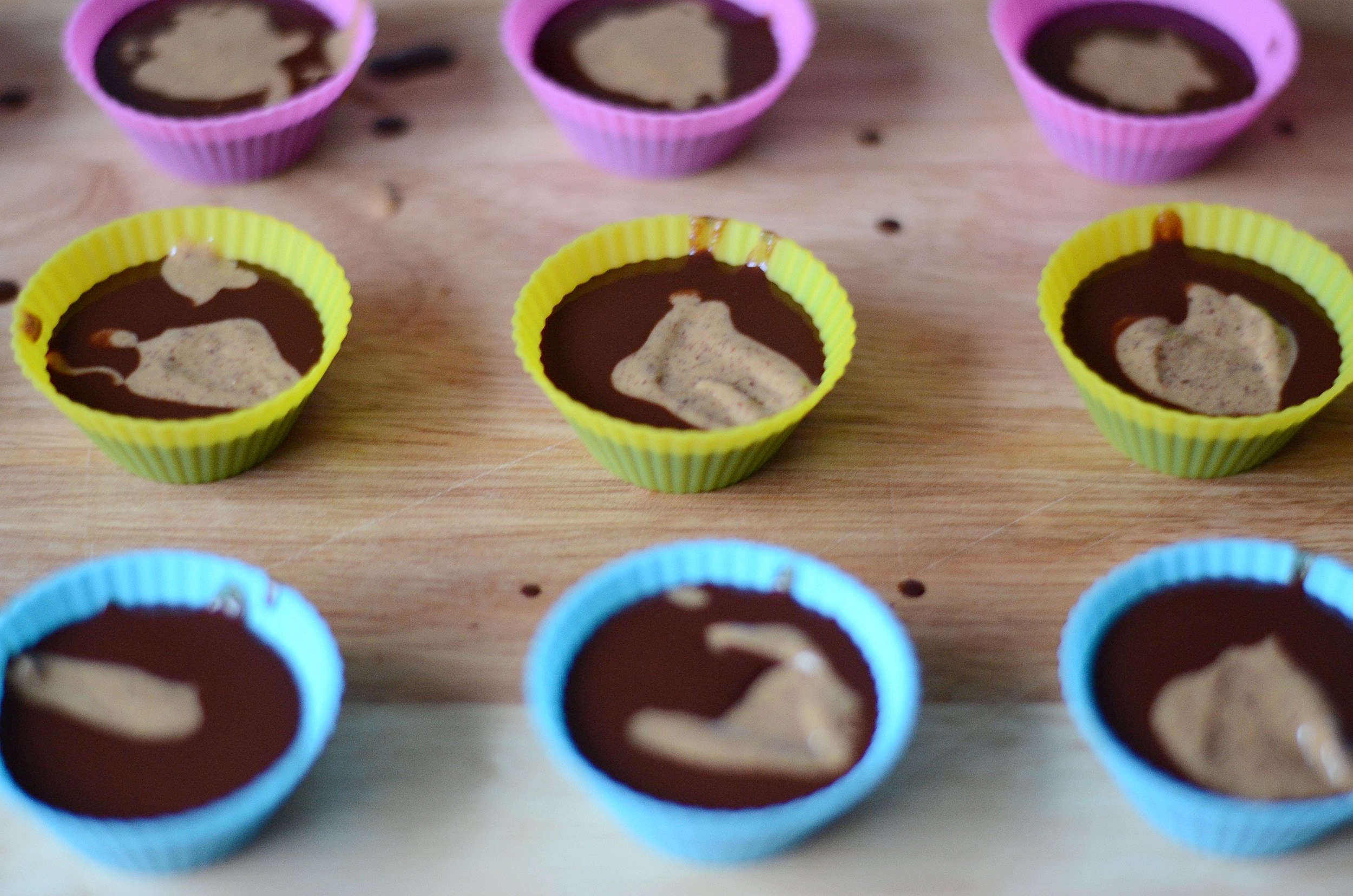
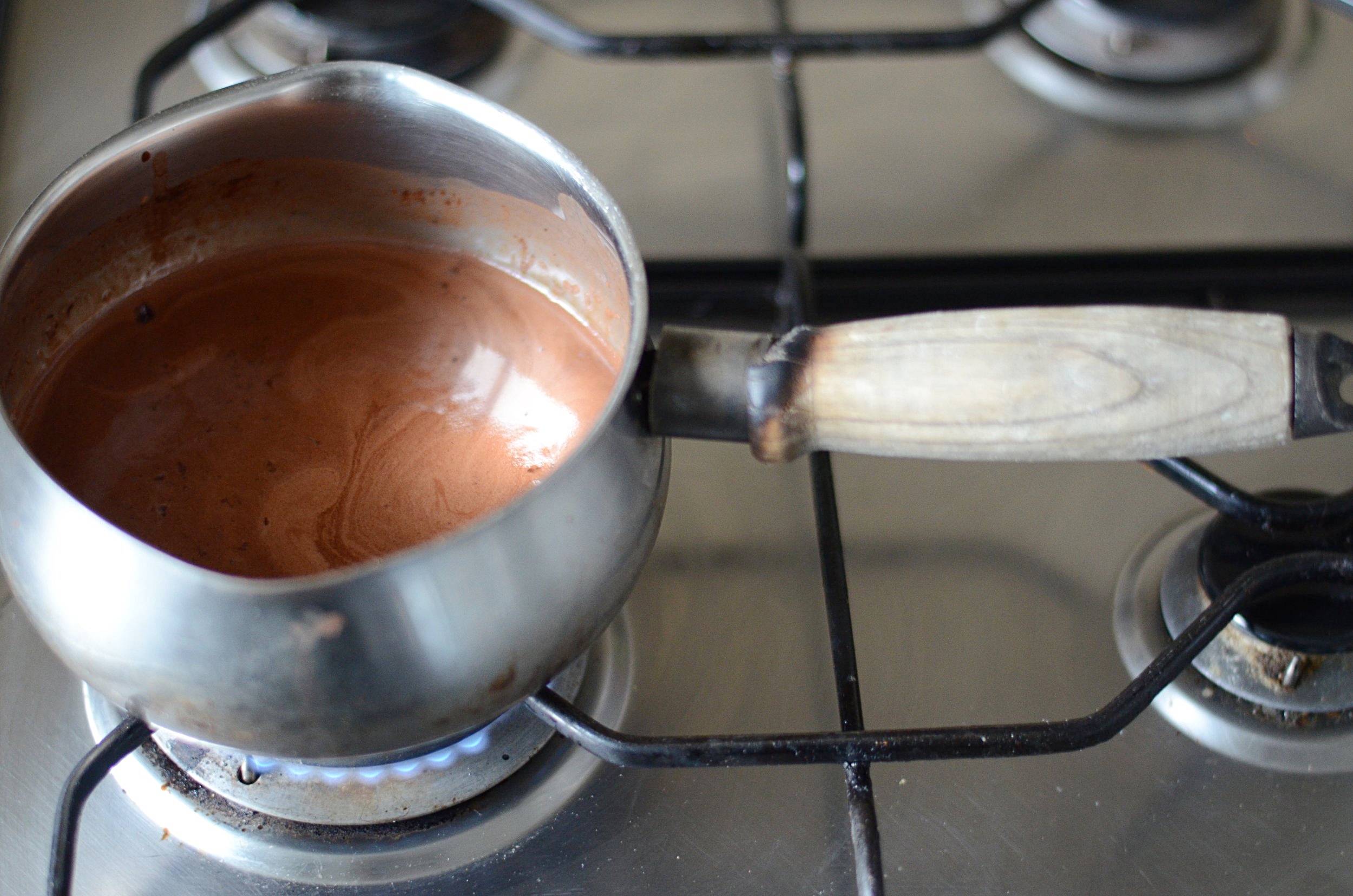
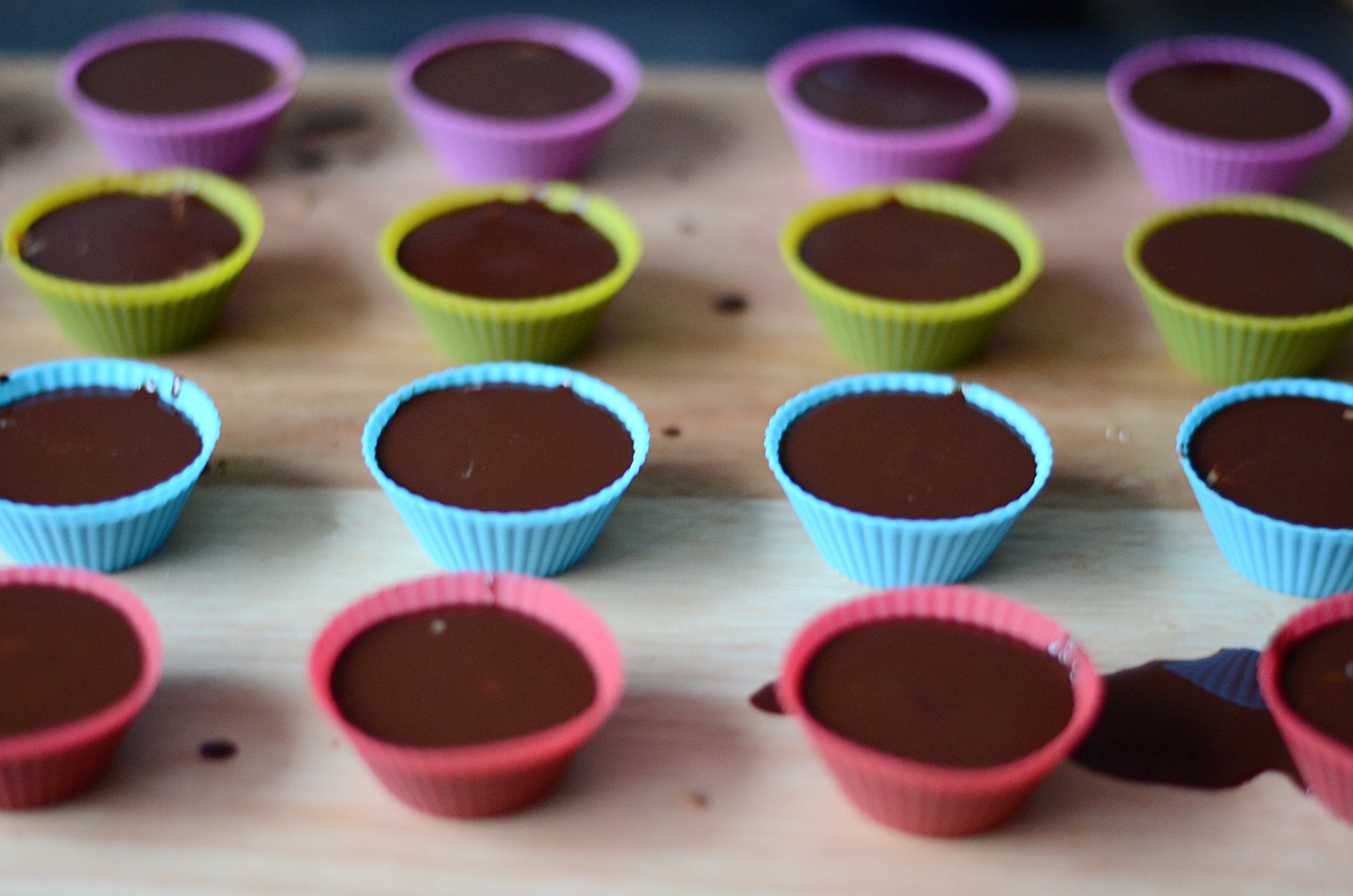
Place the silicone moulds on a chopping board or tray – something easy to transport them to the fridge on. Next, fill the pan with water, and place the Pyrex bowl in it to make a bain marie. Slowly bring the water to a gentle simmer, then add the cacao and coconut oil, melting it gently (the flavours are delicate so don't overheat). Once melted, stir in your cacao to form a rich liquid, then add the honey (or maple syrup) and salt. Pour the mix into the moulds until they are just over a third full, then pop into the fridge to set. Once firm (this usually takes 30-60 mins), dollop a teaspoon of almond butter into each mould, then cover with the remaining cacao mix (gently warm it if necessary). Pop the filled cases back in the fridge for an hour or so, then eat. They keep for about a week, but usually don't last that long in our house.
(Disclaminer: these pics were taken during the first test batch. I found that only using coconut oil, coupled with not making a bain marie, gave a bitter flavour. I'm freely sharing my mistakes so you don't make them and get to enjoy delicious chocolate cups!)
Posture Clinic: Bakasana
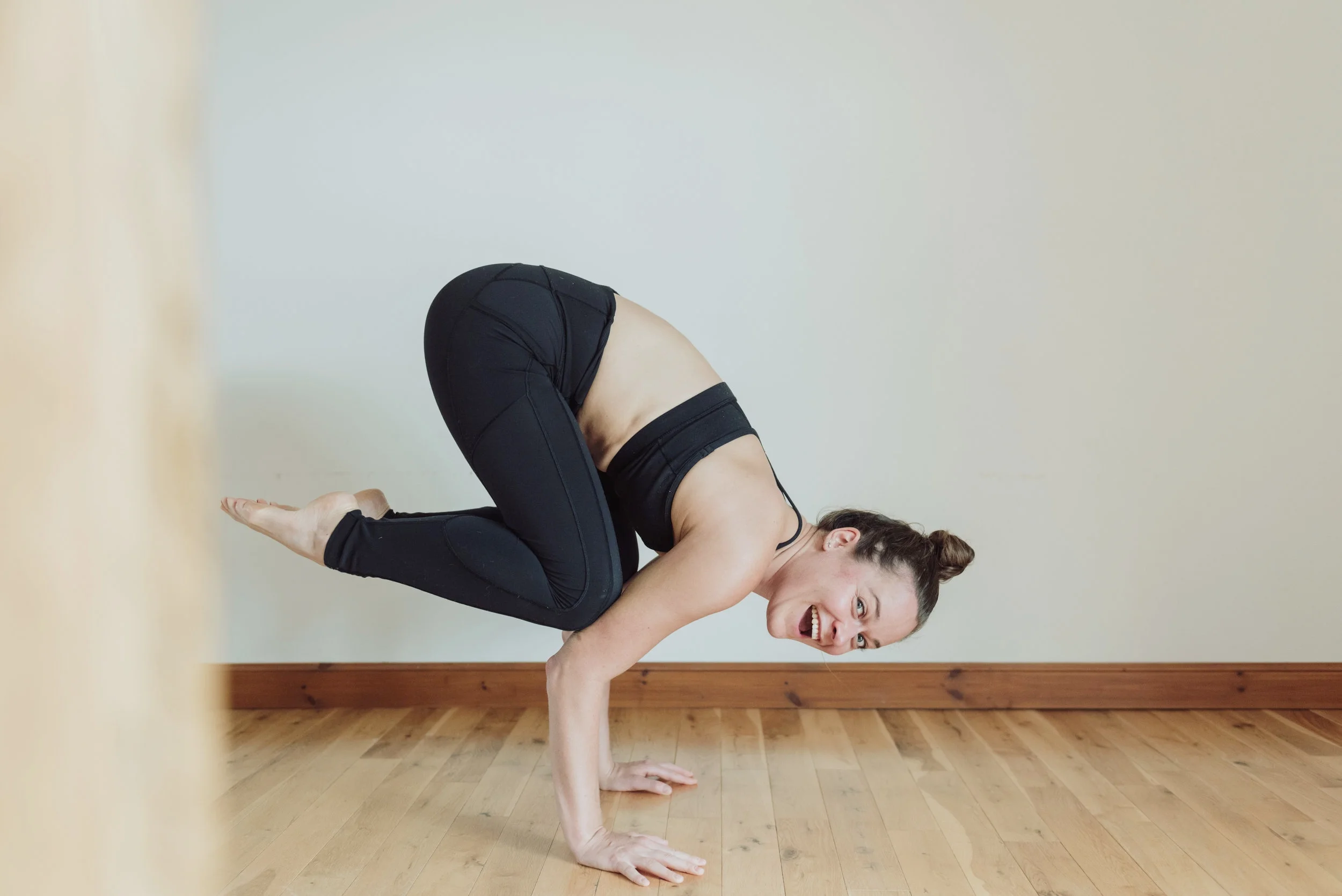
Friends, I hear you. That moment in class when the teacher invites everyone to squat and says, ‘And if you have Bakasana (crow pose), take it.’ Meanwhile, you’re sitting there slack-jawed watching everyone around you effortlessly balance their entire body ON THEIR ARMS. (On a side note: yoga is really weird, isn’t it?) Well those people who make it look effortless? It’s because they’ve put in hours and hours of practice. That’s the thing when it comes to the harder yoga poses: there is no big secret, it’s just repetition, repetition, repetition. These are the drills I swear by. READ MORE...
Friends, I hear you. That moment in class when the teacher invites everyone to squat and says, ‘And if you have Bakasana (crow pose), take it.’ Meanwhile, you’re sitting there slack-jawed watching everyone around you effortlessly balance their entire body ON THEIR ARMS. (On a side note: yoga is really weird, isn’t it?)
Well those people who make it look effortless? It’s because they’ve put in hours and hours of practice. That’s the thing when it comes to the harder yoga poses: there is no big secret, it’s just repetition, repetition, repetition.
Bakasana is essentially a squat positioned on top of chaturanga, so work on getting both of those strong and you’re halfway there. These are the drills that really helped me learn the balance, and when I share them in class with students, they too begin to find a bit of air time in the pose.
Make sure you’re warm before you try this pose: a few rounds of sun salutations should do the trick. Good luck, and let me know how you get on!
Ardha navasana
A great pose to isolate and strengthen core. Start lying on your back. Bring your hands into prayer at heart centre, draw in your navel, then lift the chest and legs off the floor a couple of inches, so you feel a sense of ‘hollowing’ in your midsection. Hold for a couple of breaths, release, repeat. Exhale to lower, inhale to lift.

Ardha Navasana
Reclined bakasana
Can't do the pose on your hands yet? Train it on your back! Lie on your mat, draw your knees in towards your chest, then open the knees wide but keep the feet and ankles touching. Curl your shoulders and upper back off the mat, keeping low belly engaged, and reach your arms forwards over your shins. Hold for 5 breaths, rest, and repeat as many times as you have energy for!

Reclined Bakasana
Navasana
Bakasana requires strong hip flexors, so Navasana it is. Come to seated, then with your legs bent, lift them to make a V-shape with your body. Hold onto the backs of the thighs and focus on drawing your navel in and up, and at the same time lift up and out of your lower back. I like to imagine a piece of string is drawing my chest up to the sky. To progress the pose, let go of the thighs while keeping knees bent, working towards extending the legs fully.

Navasana
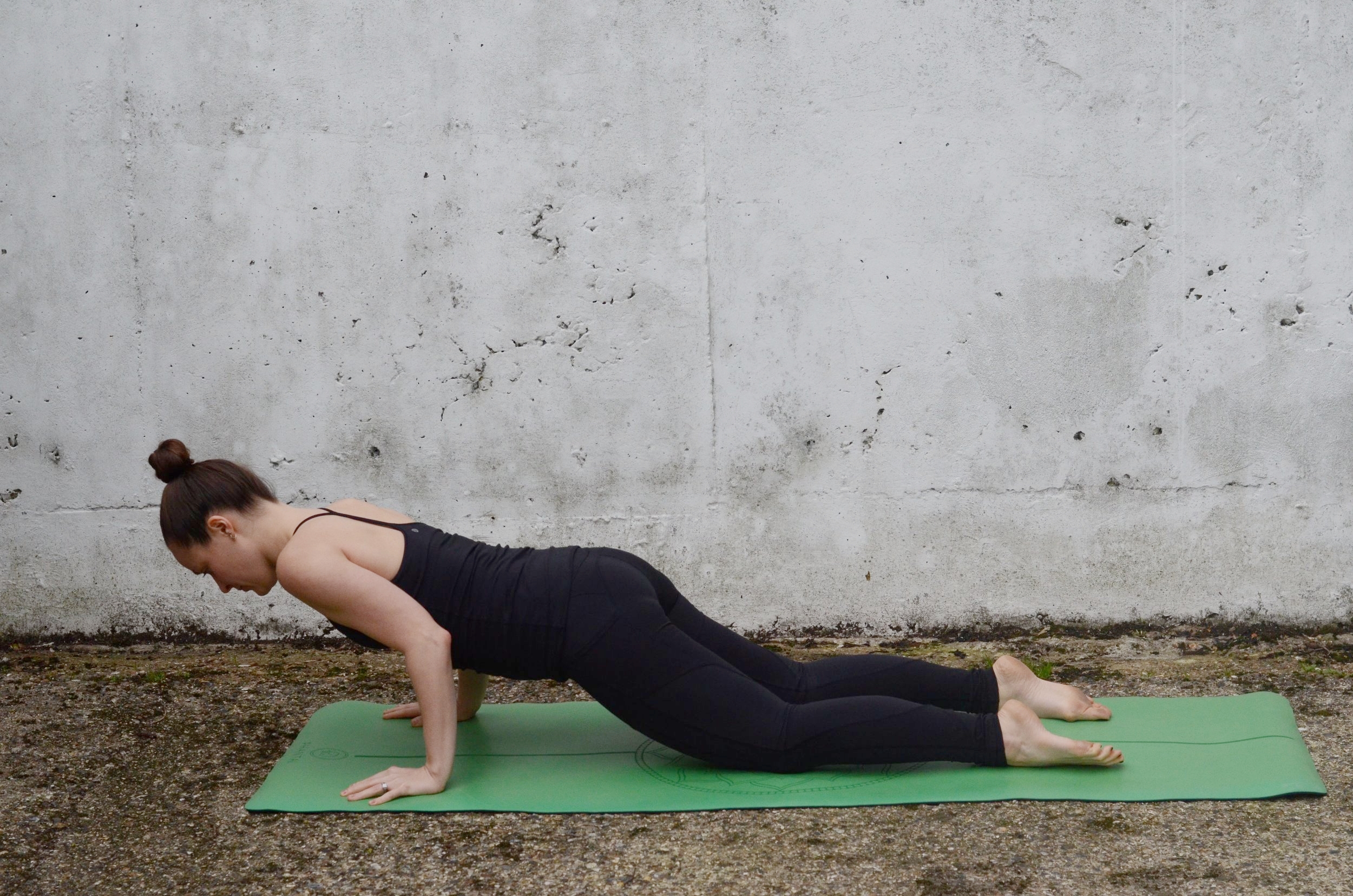
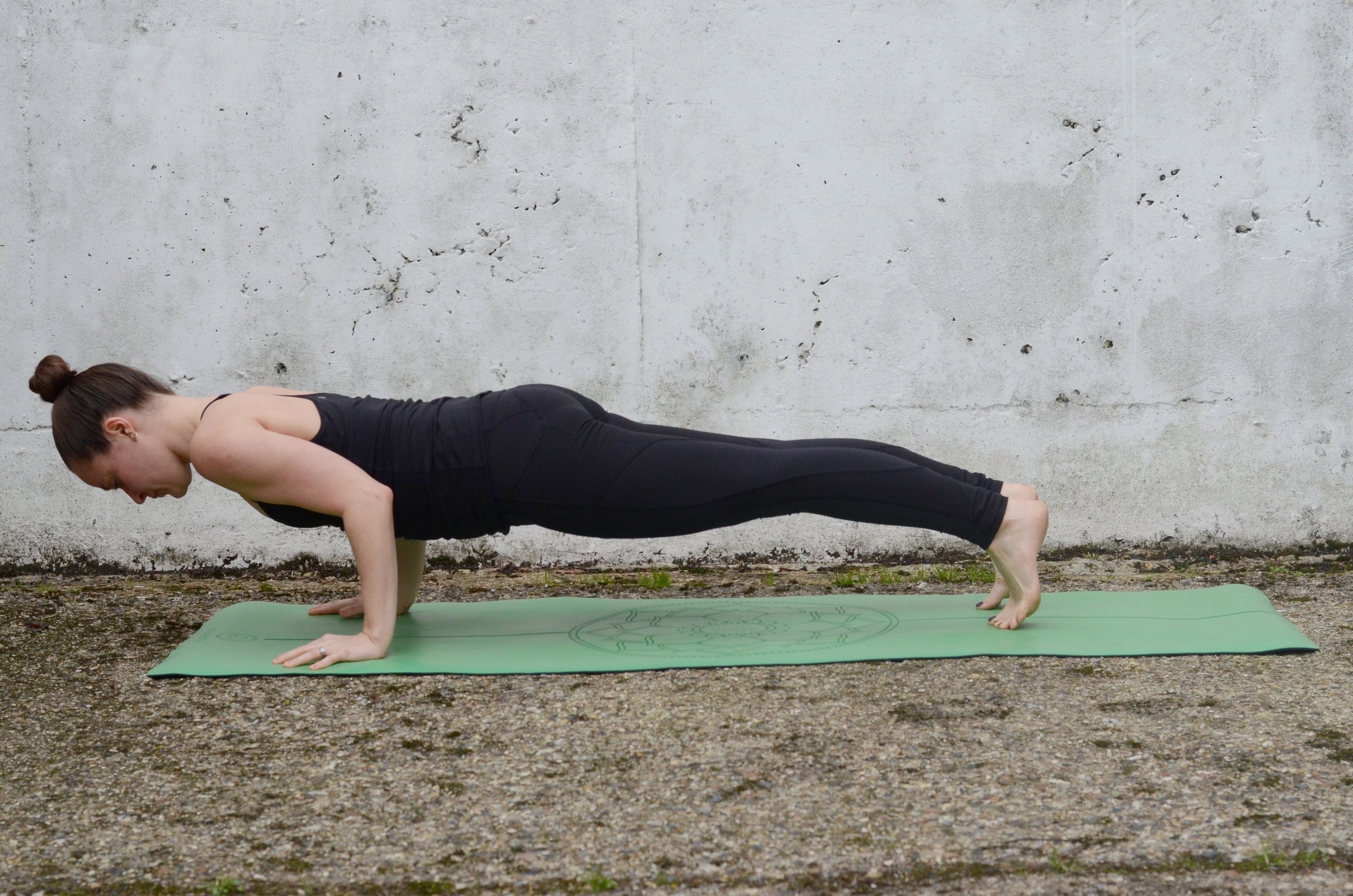
Chaturanga push-ups
A brilliant way to build upper-body strength, and the foundation of the entire bakasana family. Come onto all fours, then move your knees back an inch. Keeping your body in one straight line, bend your elbows and lower your chest towards the floor before pushing back up again. Make sure you hug the elbows in towards your ribs to engage your triceps. Try three rounds of five reps. Once you feel strong here, try it with the knees lifted, so your hips and shoulders are in line as you lower. If you start to collapse in your lower back (or feel any pain), go back to working with the knees down. This is a hard posture and takes time, so be patient.
Malasana squat
From standing, bring your legs hip-width apart (I actually like to go mat-width, but explore what feels best for your body), turn toes out slightly, then sink your hips down towards the ground. If the heels lift, prop a cushion or rolled up blanket under them for support. Bring the hands to prayer, and use the elbows to ease the inner thighs open while lifting the chest. Allow the lower back to soften towards the ground. Hold for 5-10 breaths.

Malasana Squat
And finally… Bakasana!
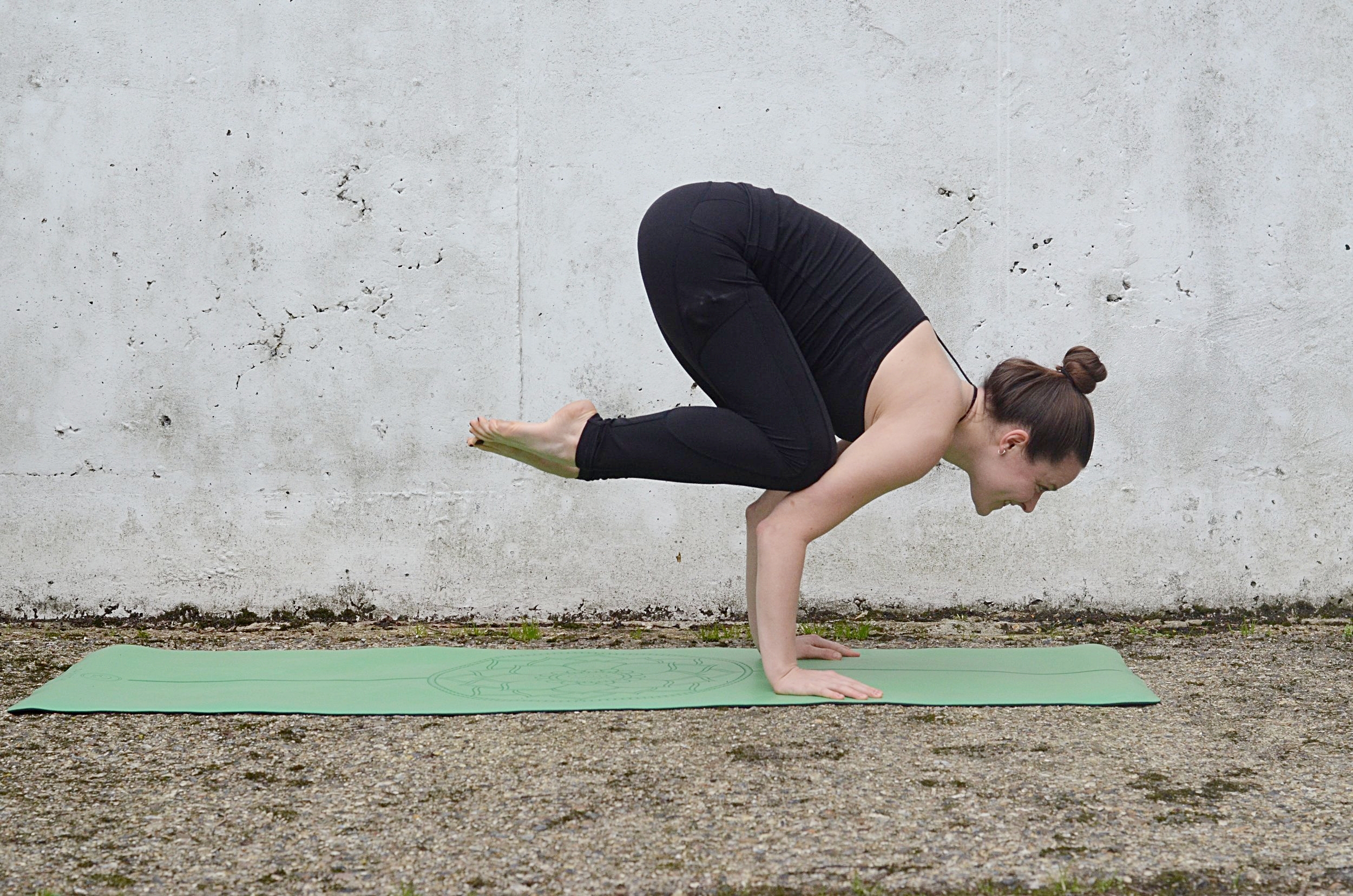
From malasana squat, bring the legs and feet together. Turn toes out slightly to open the knees. Place the hands just in front of you, shoulder-width apart, spreading fingers wide. Snuggle the knees into the backs of the arms, so the triceps create a shelf. Next, lift your hips, bend your elbows and start to shift your weight forwards. Play with lifting one foot, then the other, then maybe both.
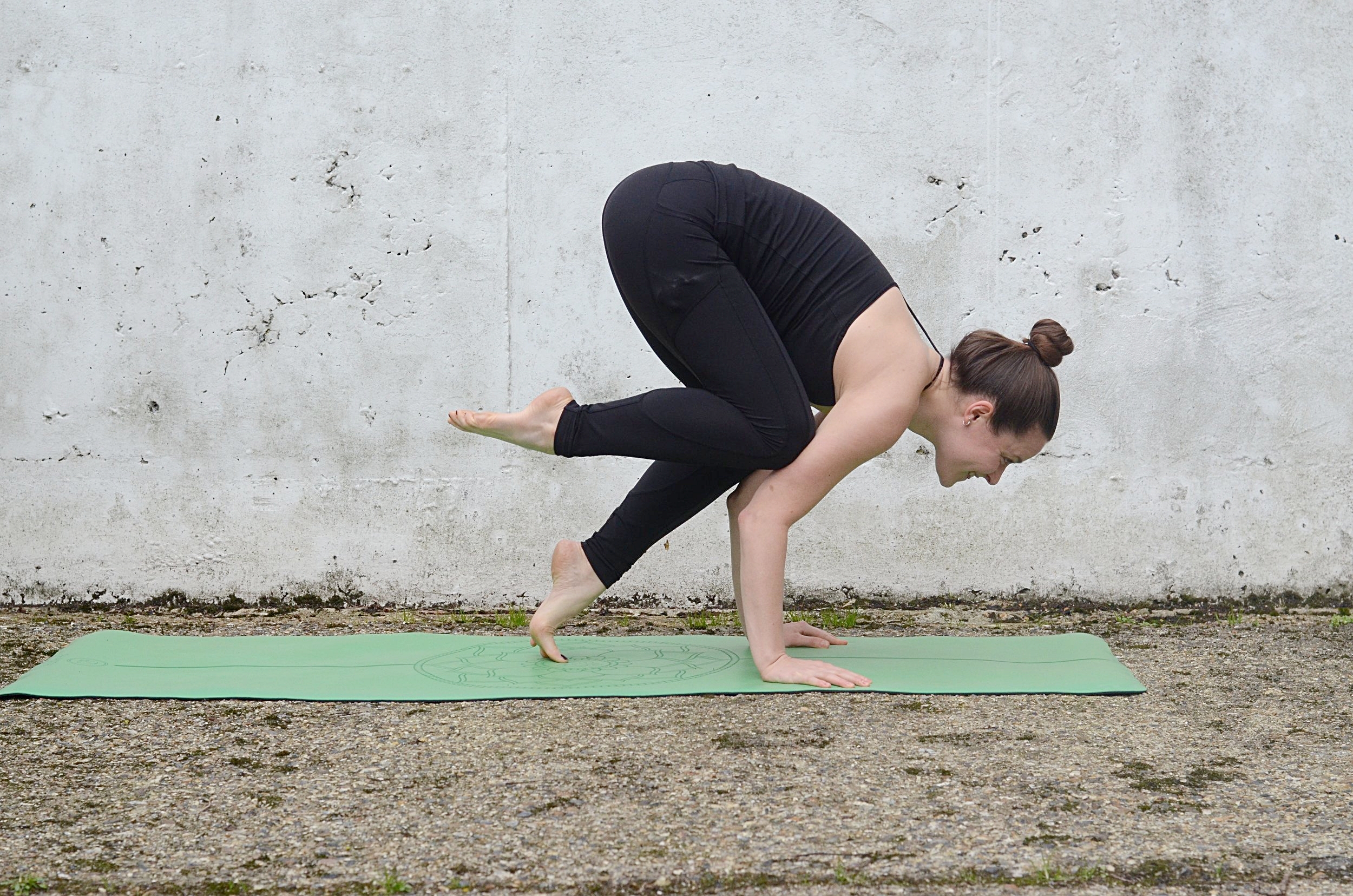
TOP TIPS
Look forwards, not down, otherwise that’s where you’ll want to go!
Squeeze the big toes together to activate pelvic floor and core
Hug the elbows towards one another to create a strong shelf-like structure
Press through forefinger, fourth finger and thumb
Place blocks under your feet to feel the elevation of the pelvis and actions of the pose, then play with lifting one foot at a time and build strength and trust
Place a cushion in front of your face, just in case!

Why Injury Can Be Our Best Teacher
If you’ve been doing yoga for a while, you’ve probably heard the phrase ‘injury can be our greatest teacher’ at some point. (If you haven't, lucky you.) Hands up, I’ve definitely heard it roll off my tongue on more than one occasion. While certain yoga cliches make my skin crawl, this one, in my humble experience, holds true. READ MORE...
If you’ve been doing yoga for a while, you’ve probably heard the phrase ‘injury can be our greatest teacher’ at some point. (If you haven't, lucky you.) Hands up, I’ve definitely heard it roll off my tongue on more than one occasion. While certain yoga cliches make my skin crawl, this one, in my humble experience, holds true.
Cut to last week however, when a weird lump appeared on the back of my right knee, while I was still recovering from breaking my finger a mere six weeks ago (and losing the nail in the process), and my first reaction was (cue John McEnroe-esque screech): ‘You cannot be serious.’ I mean, I know that I perennially need to learn to slow down, but come on universe, what are you playing at?
The worst part? It popped up (literally) the day before I was due to start module two of my advanced teacher training with Jason Crandell. I managed to make it through the two-hour morning practice on our first day, but come Tuesday I couldn’t fully flex or straighten my leg without feeling like someone was sticking hot pokers in either side of my kneecap. But you didn’t come on here to read about my medical history so long story short, I had to make an emergency trip to hospital and was unable to practice for the rest of the first week.
I'm not going to lie, it sucked not being able to practice for over a week (conflated by the fact I was sitting watching everyone else flow with seeming ease), but it turns out when you have an enforced and unexpected rest period, you have a lot of time to digest and reflect. So that's what I did. Here's what I learned, and I hope it's of some use if you do ever suffer a setback in your practice.

You can’t plan everything – learn to go with the flow
As someone who was essentially a professional planner pre-yoga life (I was the one in charge of making sure we went to press on time at ELLE), let me tell you this: sh*t happens. People miss deadlines. Certain features don’t work no matter how much you rewrite them. Cover stars fall through just before you go to press. Why did I think life beyond journalism would be any different? Injuries happen. Classes get cancelled. Events fall through. As much as it’s great to have ideas and goals, don’t be a slave to them. It will only set you up for disappointment when they don’t work out quite as you’d hoped. Next time something doesn't go quite your way, learn to adapt and go with the flow, and loosen the reins a little. Ask yourself: 'What's the worst that can happen?'
‘You have nothing to prove, and everything to gain’
I'll freely admit these words are Jason's, but they became my mantra for that week I was sitting on the sidelines watching my peers play with various arm balances, inversions, backbends and generally explore and embody what we were learning. Moving my body is my happy place, and has been such an invaluable tool for me when it comes to dealing with anxiety and depression, so to have to sit awkwardly with my leg propped on a couple of bolsters while I watched everyone else flow? That was tough. But as the week wore on and I observed how Jason expertly yet seemingly effortlessly held space for a room of 50 teachers, well, that was an education in itself, and one I wouldn’t have received had I been on the mat. So next time you find yourself building some elaborate narrative while you practice, remember that at the end of the day, the postures don't really matter. We're using the asana as a way to access the mind and learn more about who we are and how we act and react in certain situations, and through that hopefully cultivate some sense of equanimity. Which leads me onto my next point...
Meditation is a really valuable tool
My injury came just as I completed 50 days of continuous meditation (more on that another time) and I don’t think it’s a coincidence that I was able to handle it far more calmly than I would have previously. Yes, I felt vulnerable and frustrated, but those were perfectly normal emotions to experience given the situation. When I found myself getting caught up in negative thoughts I instead reminded myself to focus on the good stuff: the fact I’d been treated so swiftly; that I was still able to observe the classes and participate in everything else; that my peers were so kind and helpful (I was offered a lot of chocolate, tea and bolsters - thank you kind yogis). In short, found I was able to rationalise my thoughts and be far more accepting of the situation as it unfolded. So if you're having a tough time, I'd highly recommend building a meditation practice, even if it's just 3-5 minutes a day of quiet time to check in on what's going on within. I'd highly recommend Headspace or Insight Timer to guide you along the way.
It forces you to explore other areas of your practice
Case in point: meditation. I went deep. Even sitting in sukasana was challenging, so I had to really concentrate on not getting sucked into the vortex of intense sensation that was threatening to overwhelm me. Restorative poses became my best friend. Simple movements such as neck rolls and easy twists were a sweet release. So the next time you have an injury, rather than automatically think, 'Oh, I can't do this', shift your thought process to include, 'Maybe not, but I can do x, y and z.' You'll feel so much richer for it.
It makes you more present
That first practice after a week off? Man, it felt GOOD! I was so present and attentive (and tentative) as I transitioned from pose to pose. Poses like high lunge and warrior one felt so fresh and new, and transitioning to warrior three was a journey in itself (sample inner narrative: 'Oh god, is my knee going to hold, here goes... yes, it does, this is the best thing ever, thanks body!'). Sometimes we can get so caught up in achieving grand postures that we lose sight of the fact that there is so much nuance to explore in the foundational poses.
So as module two draws to a close and I take some time to process everything I've learnt (some unexpectedly) this past fortnight, I don’t think I can sum my experience more beautifully than this famous Reader’s Digest quote, so I’ll just leave it here: ‘Life is what happens to us while we’re busy making other plans.’
Write it down, stick it to your fridge, remind yourself to stay present and embrace the ebb and flow of life.

Blueberry And Banana Pancakes
I have a confession: I'm not the world's biggest breakfast lover. I used to be a porridge fan but, during the week at least, when I'm getting up early to teach, I tend to rely on quick and easy-to-digest smoothies. But when I do have time to luxuriate over brunch, these blueberry and banana pancakes are my go-to. READ MORE...
Start your weekend right with this breakfast
I have a confession: I'm not the world's biggest breakfast lover. I used to be a porridge fan but, during the week at least, when I'm getting up early to teach, I tend to rely on quick and easy-to-digest smoothies with a scoop of protein (kind of essential when you're demoing postures at 7am). But when I do have time to luxuriate over brunch, these blueberry and banana pancakes are my go-to. Made with just eggs and banana, they're gluten-free so don't sit heavily in your stomach and are packed with vitamins and nutrients. This makes about 8-10 ladle-sized pancakes and serves 2-3 depending on how hungry you are (my portions tend to be on the large size).
INGREDIENTS
For the pancakes
4 bananas
2 eggs
Teaspoon baking powder
Teaspoon cinnamon
Butter or coconut oil (for cooking)
1 large punnet blueberries
FOR THE COMPOTE
Frozen blueberries
FOR THE TOPPINGS
Greek or natural yoghurt
Nut butter (I love almond, but go wild)
Honey or maple syrup
Any leftover blueberries

METHOD
First, turn on your oven to 150C, then mash your bananas well in a large mixing bowl. Add the eggs, and beat well to form a smooth(ish) batter. Stir in the baking powder and cinnamon. To make the blueberry compote, add a few handfuls of frozen blueberries to a small pan with a splash of water, bring to the boil, then leave to simmer while you cook the pancakes, adding more water if needed – you want it to be reduced and jam-esque. Meanwhile, grab a large frying pan and melt the butter (or oil, if using), then using a ladle, pour three even-sized circles of mixture into the pan. Sprinkle fresh blueberries onto each one. Fry until the tops of the pancakes are starting to bubble, then flip and cook for a minute or two on the other side. Place the pancakes on a baking tray and pop them in the oven to keep warm while you cook the rest. Repeat until the mixture is finished.
To serve, stack your pancakes, then top with yoghurt, nut butter, honey and any leftover blueberries, and any other toppings you desire (I reckon cacao nibs would be a delicious addition here). Enjoy!


5 Reasons You Should Try Yoga
No one really knows what they’re doing the first time they set foot on a yoga mat. Most of us can’t touch our toes, everyone wobbles when they try tree pose, and the mental effort it takes… well, that’s something that takes years to master. It’s the falling over, picking yourself up, and trying again that matters. READ MORE...
We All Have To Start Somewhere
Let me tell you a story. Sometimes, quite often in fact, I’m lying on the sofa scrolling through Instagram, looking at Insta-yogis doing Insta-inspiring (and quite frankly inconceivable) things with their practice. Sometimes, quite often in fact, I lie there and get increasingly disheartened. More often than not however, namely because I’m quite good at giving my monkey mind a stern talking too when it needs one, I put down my phone and get on my mat because, frankly, no one gets anywhere in life by sitting there thumbing their phone.
Now I’m not saying that every practice I do is an epic 90-minute flow effortlessly linking advanced pose with advanced pose. Nothing like it. But I do make sure I get on my mat 6-7 days a week, even if it’s just to hug a bolster for a while. And that is the key to developing a regular practice: to simply show up and do the work. Some days magic will happen, other days it won’t, and that’s more than OK. What matters is the commitment, discipline and ability to stick at something when the going gets tough.
But I’m getting a bit off track here: the point of this post is that no one really knows what they’re doing the first time they set foot on a yoga mat. Most of us can’t touch our toes, everyone wobbles when they try tree pose, and the mental effort it takes… well, that’s something that takes years (decades even) to master. It’s the falling over, picking yourself up, and trying again (and again, and again), that makes this practice so beautiful. Yoga offers us a sanctuary within which we can safely explore and learn from the stories and inner narratives we all have.
So who cares whether or not you can touch your toes – here are 5 reasons you should try yoga anyway.
It allows you to discover yourself
That first time I stepped on the mat, I just got stuck right in: copying the person in front of me, thinking ‘I’ve got this, I’m so flexible, this yoga stuff is easy…’ Cut to 60 minutes in, just as the teacher was talking us out of savasana, and it was like my brain had melted. I felt so safe, so relaxed, so at ease within myself. I’d never experienced that before. It was that feeling, that sense of coming home, that kept me coming back for more. Your mat becomes a place where you go to comfort yourself, to uncover new layers, to peel back the onion so to speak. It takes you right to your core Self: who you are when you strip all the other stuff (your job, your house, your education, your car, your clothes etc) away. Case in point: by nature I’m really competitive and love being physical, yet I often try too hard and burn out or injury myself as a result. So for me, the practice is about learning to soften and accept that I can’t control everything. Maybe you’re similar, maybe you’re the exact opposite: your mat is the place to uncover, explore and rebalance your tendencies.It gives you a sanctuary
As someone who has struggled with anxiety and depression since my teens, my mat is a real safe haven. If I’m having a bad day, I go get on my mat and will more often than not have a really muddled, confused, erratic practice that reflects my mental state. Sometimes I’ll have a little cry too. Other times, I’m so at one with body and breath it just feels effortless. Your mat is a place to allow all these emotions, the full spectrum of them, bubble up. Honour them and explore them: you’ll feel so much freer for it.It makes you stress less
Yoga and breath are intrinsically linked. The breath helps us find that mind-body connection, encouraging us to move in harmony with it. Slowly but surely, you start to find that when you’re practising, your mind isn’t really thinking about anything else: you’re here, in this moment, just moving and breathing and being in your body and feeling alive. Kapow! You’re BEING PRESENT! Stress has a tendency to rear its ugly head when we’re worrying about the past or the future – in the present moment there is no fear. Yoga – and its focus on being present – helps you build a stress-relieving toolkit that you have with you whenever you need it.It reduces your risk of injury
A lot has been written lately about how dangerous yoga is. Sure, if you a headstand where you’re on the wrong part of your head and you’re not pressing down through your arms, you probably will injure yourself, and you should probably slow down, focus on learning the basics and building strength, then try again once your foundations are solid. But everything in life comes with some level of risk factor, and surely it’s better to move and breath and get into your body than lie on the sofa watching Netflix - I would argue that that is, if anything, more dangerous. But I’m going off on a rant here. Yoga encourages us to be fully present and move mindfully. Through doing so, we build better body awareness, thus minimising the risk of injury. Does a pose feel uncomfortable in your body? Then back off or come out of it, and ask your teacher for an alternative. Moreover, your muscles are only as strong as they are flexible, so it’s important to balance out whatever other training you’re doing (running, cycling, weight training, CrossFit) with yoga to improve mobility. You’ll feel so much stronger for it. Yoga teaches you to be aware of and compassionate towards your body. If something hurts, don’t do it - seek an alternative pose. Which leads me onto my final point...It teaches you to listen to – and love – your body
The great thing about yoga is you can modify or intensify your practice as much as you need to on any given day. Feeling tired? Let yourself rest in child’s pose as much as you need to. Feeling like you need to burn off excess energy? Do those extra chaturangas and handstand hops. Old injury playing up? Ask your teacher how you can modify and feel empowered that you’re looking after your body. Self care is key. I’ve honestly - despite all the tiny, toned, Lycra-clad yogis I see daily on social media - have never felt better about my body than now, age 34, 10 years into my yoga practice. Practising yoga makes me feel strong and able, which is empowering, and it’s also encouraged me to soften and accept what is, and treat myself with compassion and kindness, and I think we could all do with a little more of that, right?